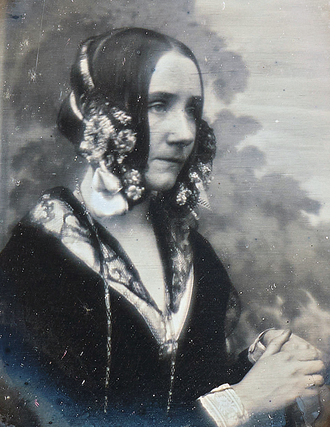
Ada Lovelace: Visionary of "Poetical Science" and Computing
Augusta Ada King, Countess of Lovelace (1815–1852), was an English mathematician and writer celebrated as the world's first computer programmer. The only legitimate child of the famed Romantic poet Lord Byron and reformist mathematician Lady Anne Isabella Milbanke, Ada's upbringing was deliberately steered toward mathematics, logic, and astronomy by her mother to temper any hereditary "Byronic" poetic volatility. Guided by prominent mentors, including the pioneering Scottish polymath Mary Somerville and mathematician Augustus De Morgan, Lovelace merged rigorous analytical discipline with boundless imaginative insight—a synthesis she famously termed "Poetical Science." [1, 2]
In June 1833, seventeen-year-old Lovelace was introduced to Charles Babbage and his prototype mechanical calculating machine, the Difference Engine. Fascinated by the machinery, Lovelace forged a lifelong intellectual partnership with Babbage as he designed his far more ambitious machine: the steam-powered, general-purpose mechanical computer known as the Analytical Engine.
Note G: The World's First Computer Algorithm
In 1842, Italian engineer Luigi Menabrea published a French paper describing Babbage’s Analytical Engine. Lovelace spent nine months translating the paper into English, appending her own extensive commentary labeled Notes A through G. Her notes were more than three times the length of the original text.
- Symbolic Generalization Beyond Numbers: While Babbage viewed his machine as a lightning-fast numerical calculator, Lovelace saw that anything expressible through logical rules—including musical notes, geometric graphics, and language—could be manipulated by the engine: "The Analytical Engine weaves algebraical patterns just as the Jacquard-loom weaves flowers and leaves."
- Note G (The Bernoulli Algorithm): In Note G, Lovelace published a complete, step-by-step table of instructions for calculating Bernoulli numbers using the Analytical Engine. Her plan incorporated modern computing paradigms: operational execution tracks, memory storage locations (variables), conditional branch loops, and accumulator registers.
Learn the idea: Algorithms, State Traces, and Loops
Before you start: You need integer operations and the concept of an accumulator. An algorithm is an unambiguous, finite sequence of mathematical instructions designed to solve a specific class of problems.
To understand how Lovelace’s algorithm functioned, modern computer scientists use a State Trace Table. The table tracks memory variables before and after every clock cycle:
Worked Example 1: Simulating an Accumulator Loop
Suppose an algorithm calculates the sum of squares for the first 3 positive integers (\(1^2 + 2^2 + 3^2\)). Let memory register \(A\) be the accumulator (initial total = 0), and let register \(N\) be the counter (initial value = 1).
- Cycle 1 (\(N = 1\)): Square \(N\): \(1 \times 1 = 1\). Add to accumulator \(A\): \(0 + 1 = \mathbf{1}\). Increment \(N\) to 2.
- Cycle 2 (\(N = 2\)): Square \(N\): \(2 \times 2 = 4\). Add to accumulator \(A\): \(1 + 4 = \mathbf{5}\). Increment \(N\) to 3.
- Cycle 3 (\(N = 3\)): Square \(N\): \(3 \times 3 = 9\). Add to accumulator \(A\): \(5 + 9 = \mathbf{14}\). Loop terminates.
The final state in register \(A\) is 14. Notice that without an explicit stopping condition (terminating when \(N > 3\)), a computer would enter an infinite loop, freezing the machine!
Worked Example 2: Tracking State in Modern Python or JavaScript
When you write a modern programming loop:
let total = 0; for(let i = 1; i <= 3; i++) { total += i * i; }
Your computer's microprocessor executes the identical mechanical sequence of fetch-decode-execute cycles that Lovelace mapped onto brass gears, punched cards, and levers in 1843!
Try it yourself: Two Algorithmic Puzzles
Puzzle 1: Start with register \(X = 2\). Execute the loop instruction "multiply \(X\) by 3" exactly three times. What is the value stored in \(X\)?
Show answer and explanation
Cycle 1: \(2 \times 3 = 6\). Cycle 2: \(6 \times 3 = 18\). Cycle 3: \(18 \times 3 = \mathbf{54}\). The final value is 54. Note: repeatedly multiplying is exponential growth (\(2 \times 3^3 = 54\)), not repeated addition (\(2 + 3 + 3 + 3 = 11\)).
Puzzle 2: What occurs if an algorithm lacks a clear "termination condition"?
Show answer and explanation
The machine executes instructions indefinitely in what modern computer science terms an infinite loop. The program never returns an output, depletes processor resources, and crashes the system. Lovelace accounted for finite termination in all her engine traces.